Matthew Madigan
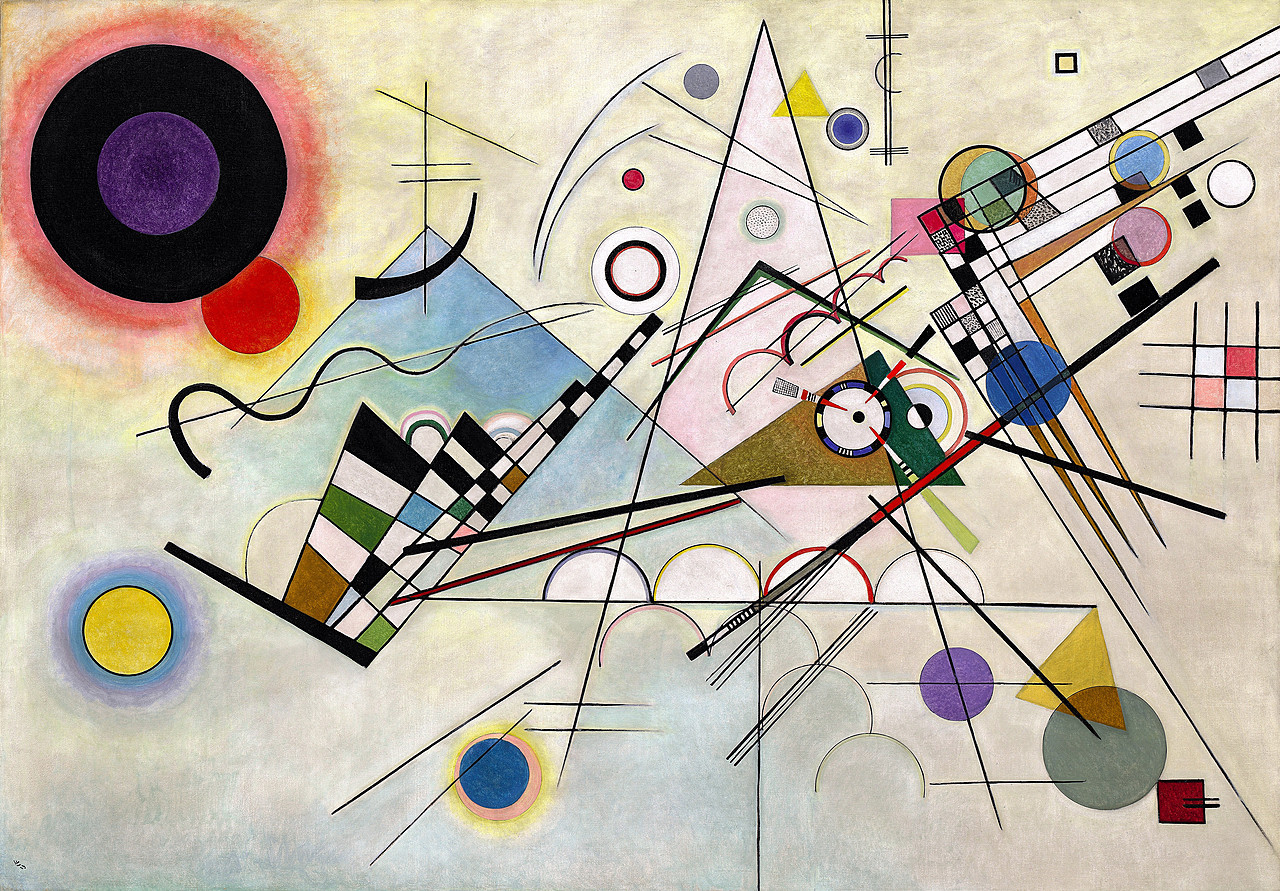
This thesis explores Wassily Kandinsky's colour-sound associations through an interactive music installation. This was executed through the use of Ableton and Max, allowing motion detection and audience-driven interactivity to become the primary creative input. The visual foundation of the installation was Kandinsky's painting 'Composition VIII'; each geometric element within the painting was allocated a sound, with each sound being composed in accordance with Kandinsky's colour-sound associations.
This installation was showcased in IADT, and qualitative data was collected through the means of a survey. Questions were asked in relation to immersion, geometric mapping and colour-sound associations.
The question which lies central within this project was, how do users perceive and interact with Wassily Kandinsky’s colour-sound associations in an interactive music installation?
To answer this question, the following aims were established:
1. Examine Kandinsky’s relationship with synaesthesia and develop an advanced understanding of his colour-sound associations.
2. Create an interactive music installation using Ableton and Max, in which audience-driven interactivity is the primary creative input.
3. Assess user perception of colour-sound associations through a post-interaction survey.
4. Evaluate the effectiveness of audience-driven interactivity and geometric mapping as a form of communicating Kandinsky’s theories.
5. Identify possible future developments based on user feedback.
This project was undertaken to explore how users perceive and interact with Wassily Kandinsky’s colour-sound associations in an interactive music installation, guided by 5 established aims. Through creating an interactive installation, showcasing it to peers and receiving analytical data through a digital survey, the findings were positive for the vast majority. With 74% of users completely unaware of Kandinsky, statistics such as 89.4% of users perceiving a connection between the colours and sounds, and 100% of users finding the installation immersive, are quite profound. The data collected suggests that the installation efficiently communicated Kandinsky’s theories to a largely uninformed audience.
This project positions itself within the ever-growing interactive installation industry, specifically within the underdeveloped industry sector of still art integration. Kandinsky’s theories were explored through digital means, offering users a new perspective on his work and mind. As one participant noted, what technologies or artwork Kandinsky would have created in this era will never be known, but this installation provides the closest thing to that answer. Though the data presented overwhelmingly positive responses, some limitations were identified. These criticisms present opportunities for development in future interactive projects undertaken.
My name is Matthew Madigan. I am 22 and have developed a great passion for audiovisual systems, particularly interactive installations. This project allowed me to combine my love for Kandinsky's artwork with my passion for audiovisual projects. Creative Music Production has allowed me to experience all aspects of the music industry. Giving me the confidence and expertise to build this installation, alongside my own artist management and promotions company - Spitball Management. This course has shown me that music production can come in many different forms. I am very grateful for that and look forward to where my journey will take me.